The Open Invitation Myth: Why Everyone May Not Feel Included
An open invitation can still leave people unsure how to join. Learn how arrival routines, meeting formats and shared tasks shape who feels able to take part.

The most common mistake with an open invitation is treating the word “welcome” as proof that anyone can take part comfortably. An invitation to a neighborhood meeting may say everyone is welcome while leaving newcomers unsure whether they are expected to speak, know the group’s history, or take on work. That gap can cost a project useful participation.
Rather than polishing the invitation’s wording, look at what happens once someone accepts it. The first conversation, the meeting’s pace, and the way tasks are shared can either make room for a newcomer or quietly reserve the gathering for regulars.
What does participation look like after someone arrives?
An invitation can already explain the activity, location, timing, and access arrangements. The remaining question is whether people can take part without copying an established member’s habits. A newcomer may want to listen before speaking, ask a clarifying question, or help with a bounded task instead of joining a long discussion.
Give these forms of participation real standing. A host might explain that people can listen, ask questions, or sort suggestions into themes, and that no one has to take a speaking turn. If the group needs a decision, distinguish between hearing input and holding a vote; they are different roles, not interchangeable signs of inclusion.
Say what contribution is useful at this stage. “Help shape the project” can suggest that participants need a complete proposal, while “mark which map locations need more discussion” describes a manageable action. Avoid offering a small task as a token if the consequential decisions are already closed.
How can a group make room without putting anyone on display?
A host can support participation without turning a newcomer into the evening’s special subject. Introduce the meeting format to everyone, not only to the person who appears unfamiliar. For example, explain that people may pass when invited to speak and that questions can be raised during the discussion or afterward.
Do not make a round of introductions the price of entry. If names and roles matter for the work, let people share only what is relevant and give them an option to pass. A quiet arrival does not need diagnosing; it may simply be how someone prefers to begin.
Group habits deserve the same scrutiny. If regulars refer to an earlier decision, pause to give the context needed to understand the current choice. If someone uses a term that is specific to the project, explain it without making the person who asked feel responsible for interrupting the meeting.
Which participation choices help people contribute?
- Check whether a newcomer can listen without being called on; if yes, say that listening is a valid way to join, and if no, explain the speaking expectation before they attend or offer another format.
- Check whether the task has a clear boundary and a visible result; if yes, offer it as an option, and if no, define a smaller action or have a regular member handle it.
- Check whether the decision is genuinely open; if yes, identify how input will affect it, and if no, ask for feedback only on matters that can still change.
- Check whether a person can leave a task or discussion without explanation; if yes, state that plainly, and if no, change the arrangement or make the commitment explicit before participation begins.
- Check whether a quieter contribution can be shared in writing or one-to-one; if yes, name the route, and if no, arrange a way to hear input without requiring a public speaking turn.
- Check whether a newcomer is being asked to explain or represent a whole group; if yes, remove that expectation and invite individual input on the same terms as everyone else.
These checks are about the work itself, not about persuading every person to participate in the same way. A group may need people to do particular tasks, but it should be candid about that need and avoid presenting an optional activity as a requirement.
What does a workable first contribution look like?
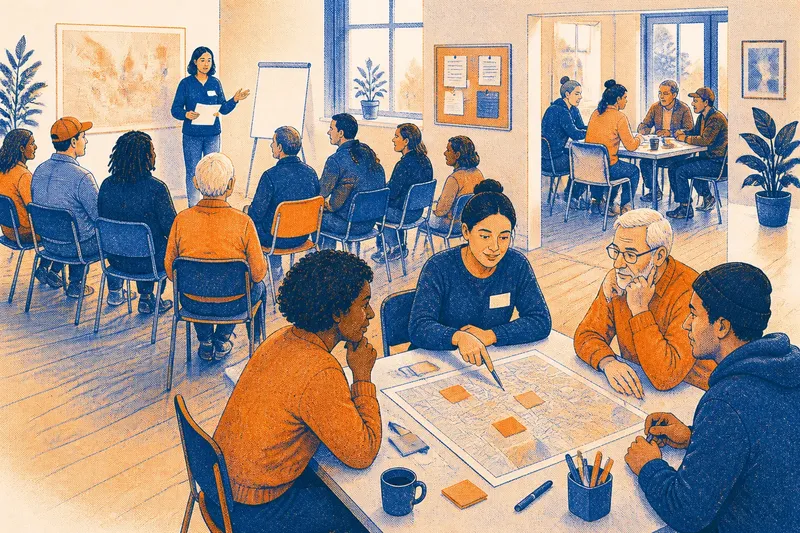
Say you are helping a neighborhood group review a draft map of a proposed walking route. The map has three marked crossings, and the group has not yet decided which one to discuss first; those are invented details for this example. You arrive without knowing anyone. The host explains that you can listen, write a note, or speak during the discussion, and that the group will use comments to choose which crossing needs attention. You write that the crossing beside the playground entrance needs a clearer description, then hand the note to the host. The observable result is a specific issue added to the discussion without requiring you to lead it or claim expertise. The tradeoff is that a written note may not capture follow-up questions, so the host can offer to clarify the point afterward.
The example works because the contribution has a clear destination: the group can see what the note concerns and decide whether it changes the next discussion. “Come and share your perspective” does not provide that same clarity if no one knows who will use the response or how.
How can participation feel less like a test?
Can someone attend without speaking?
Yes, if the group does not need spoken input from every attendee. State that people may listen, take notes, or pass when a turn is offered, and explain any part of the process that does require a response.
How should a group handle people who arrive late?
Have a member quietly explain what the group is doing and where the discussion stands. If a late arrival would miss a decision they need to understand, pause briefly or provide a concise recap without restarting the whole meeting.
What if a participant asks a basic question?
Answer the question directly and supply enough context to make the answer useful. Avoid treating it as a test of whether the person has read every earlier message or attended a previous gathering.
How can someone contribute without joining every meeting?
Offer a defined way to share a comment or complete a bounded task between gatherings, then be clear about how that contribution will be considered. Do not imply that an off-site option has the same effect if the group will make decisions before receiving it.
What is not worth the effort?
A lengthy speech about how inclusive the group is rarely helps as much as a well-run meeting. Nor is it useful to create a special task merely to keep a newcomer busy while regulars make all meaningful decisions. The point is not to manufacture participation, but to make genuine choices and contributions legible.
Open invitation participation depends on more than who is allowed through the door. Before the next gathering, review the meeting’s actual decisions, tasks, and speaking routines. If a newcomer can understand what is open to influence and choose a useful way to engage, the group has made participation clearer without requiring anyone to perform confidence.