A Circle, a Table or Rows: Choosing a Room Layout
Choosing a room layout shapes who can speak, listen, and work together. Match circles, tables, or rows to the exchange your gathering needs.
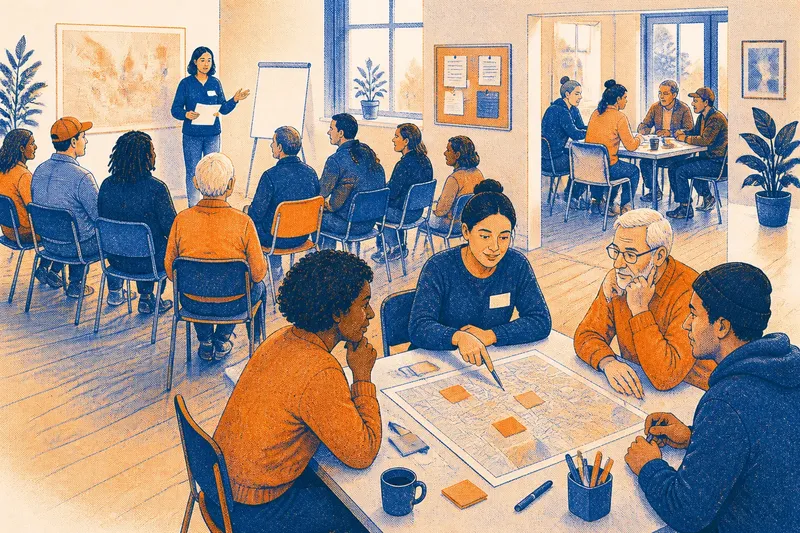
The most common room-layout mistake is choosing whatever arrangement takes the least effort before asking what people need to do together. Choosing a room layout poorly can make a useful gathering feel like a lecture, or a focused discussion feel like a queue for the floor.
Circle, table, and row arrangements each make certain exchanges easier and others more awkward. Choose for the main activity, then adjust for the room, access needs, and the people expected to attend.
What does each room layout make easier?
A circle makes face-to-face conversation easier, a table supports shared work, and rows direct attention toward a speaker or display. Those are tendencies, not rules: a circle can become a meeting with a dominant voice, and rows can still host discussion if the gathering includes deliberate ways to participate.
Start by naming the action you want most: listening, talking across the group, or handling materials together. If a gathering mixes these, choose the layout for its longest or most important activity and plan a simple transition for the rest.
When is a circle the better choice?
Choose a circle when participants should be able to see one another and contribute to a shared conversation. It suits a listening session, a small planning discussion, or a gathering where neighbors need to respond to each other rather than only to a facilitator.
Leave enough room for chairs to be approached and for people to enter or leave without squeezing past others. A full circle can feel exposed to someone who would rather listen first; a broad arc, with an open side near the entrance, offers a less demanding way to join. The facilitator can sit as part of the group instead of claiming a separate front position.
A circle is less helpful when people need to write, sort papers, or use tools for much of the session. Participants may end up balancing clipboards on their knees, a small inconvenience that tends to become the main event.
When do tables help people work together?
Use tables when the gathering involves drawing, sorting, writing, assembling, or comparing physical materials. A shared surface gives people somewhere to put maps, cards, markers, or sign-up sheets, and it makes side-by-side work practical.
Small tables can support several working groups, while one long table can keep the group focused on a single shared task. Leave clear routes between tables and avoid placing all useful materials at one crowded end. If the work needs a whole-group conversation as well, arrange chairs so people can turn toward one another without treating the table’s head as a permanent stage.
Tables can also create small islands. If everyone needs to hear updates, make sure people can see the person speaking and that voices carry across the room. A table arrangement is not automatically collaborative; it is just a surface with chairs around it.
When are rows the right choice?
Rows work when most people need to look in one direction: for a short presentation, a demonstration, a film, or a clear announcement. They use a room simply and can keep sightlines focused on a speaker, screen, or work area.
The trade-off is that conversation between attendees takes more effort. People must turn around, and those seated at the edges may feel farther from the activity. If questions or discussion matter, leave room for a brief pair conversation or arrange a few chairs at the side for a less formal exchange. Rows are a poor fit for a session whose main purpose is to make decisions through conversation.
How should access and comfort change the arrangement?
Keep routes to the door, restrooms, and any activity area clear, and leave spaces where people using mobility devices can join the group rather than watch from outside it. Avoid relying on a single narrow gap or placing an essential seat where someone must ask others to move each time they enter or leave.
Consider sound, sightlines, and the amount of time people will remain seated. A speaker facing a bright window may be difficult to see, while a noisy hallway can make a quiet discussion hard to follow. Offer a choice of seats where possible, and do not assume every participant wants to be at the center of attention. For furniture limits, room capacity, and access requirements, follow the venue’s guidance and applicable local rules.
How can you switch layouts without losing the gathering?
Change the arrangement only when the next activity gains enough from it to justify the interruption. Moving chairs takes attention away from the discussion, so explain the reason, ask for help where appropriate, and keep a clear route open while furniture is being moved.
Say you are hosting a neighborhood conversation that will begin with a short update and then sort ideas on a paper map. You could start with chairs in a broad arc facing the map, then ask participants to move into pairs at nearby tables for the sorting activity. The expected observable result is that everyone can hear the opening and later has a surface for working; the layout serves two distinct tasks without requiring a full room reset.
When a change would create confusion or interrupt a useful exchange, keep the existing arrangement and adapt the activity instead. A short paired discussion can work from rows, and a paper map can be brought to a circle if people only need to mark a few locations.
Which room layout questions do people ask?
Is a circle always more inclusive?
No. A circle supports visibility, but being seen by everyone can feel uncomfortable, and a fast-moving discussion can still favor confident speakers. Offer ways to contribute without taking an uninterrupted turn, such as passing or writing a note.
Are tables better for a small group?
Use tables if the group needs a shared work surface, not simply because the group is small. For conversation alone, a circle or open arc may make it easier to address the whole group.
Can rows work for a discussion?
They can, especially for a short exchange after a presentation. Build in a way for people to speak with someone nearby or ask questions, since the arrangement itself points attention forward.
What if the room cannot be rearranged?
Keep the fixed furniture and change how people use it. Invite a brief turn-and-talk, bring materials to participants, or use a smaller discussion area without blocking exits or access routes.
What is not worth arranging?
Do not spend the gathering’s preparation time pursuing perfect symmetry or matching every chair angle. Clear paths, usable surfaces, and a layout suited to the main exchange matter more than a room that looks composed in a photograph.
Choosing a room layout is ultimately a decision about the exchange you want to make easy. A circle invites people to address one another, tables put shared work within reach, and rows make a common focal point clearer. Check the room once participants are present: if someone cannot see, reach, hear, or join comfortably, make the smallest adjustment that fixes the problem.